
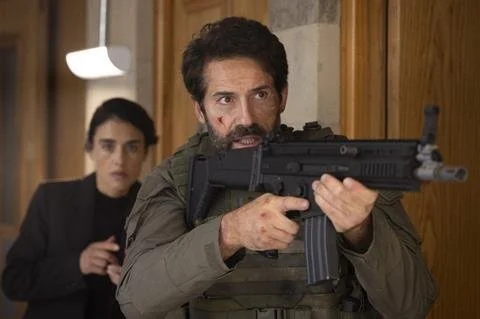
One Last Shot Movie
One Last Shot: Designing the Continuous Narrative
The Challenge: No Room for Error
Designing One Last Shot required a total departure from traditional production design. In a standard film, the "magic" happens in the cuts—we can hide equipment, swap walls, or cheat angles. In a single-shot thriller, the environment is 360 degrees of accountability. Every inch of the set had to be "camera-ready" at all times, as the lens moved fluidly between intimate close-ups and wide-angle action sequences without a single break.
Strategy & Execution
To maintain the tension of an action thriller while ensuring a seamless visual flow, my approach focused on three core pillars:
1. The 360-Degree Canvas
Since the camera followed the protagonist through multiple environments, there was no "behind the scenes" space.
• Practical Integration: I integrated lighting fixtures directly into the set design (practical lights) to ensure the Director of Photography had consistent illumination without traditional film lamps cluttering the floor.
• Hidden Tech: We designed custom furniture and structural elements with hollow cavities to hide sound equipment and battery packs, allowing the crew to move freely behind the camera.
2. Spatial Choreography
The set wasn't just a background; it was a map for the choreography.
• Pathfinding: I worked closely with the Director and Stunt Coordinator to ensure the layout dictated the pace of the film. Narrow corridors were designed to heighten claustrophobia during chase scenes, while larger hubs allowed for complex combat maneuvers.
• Durability: Because the action was continuous, the sets had to withstand high-impact stunts take after take, with no time for "set dressing resets" between shots.
3. Environmental Storytelling
Without the luxury of montage to show the passage of time or character depth, the environment had to do the heavy lifting.
• Layered Detail: Every room was dressed with deep narrative layers—discarded items, wear-and-tear patterns, and "lived-in" textures—ensuring that as the camera panned, the audience was constantly absorbing information about the world.
The Result
The design of One Last Shot serves as a silent protagonist. By creating a fully realized, unbroken world, we allowed the audience to lose themselves in the relentless momentum of the story. The result is a visceral, uninterrupted experience where the production design provides the structural backbone for the film’s adrenaline-fueled heartbeat.
"In a single-shot film, the production design is the invisible hand that guides the camera. If the audience notices the set, we’ve broken the spell. If they feel the tension of the space, we’ve succeeded."